
Dog Rope Toys: Safe Play, Smart Choices, and Travel Ideas
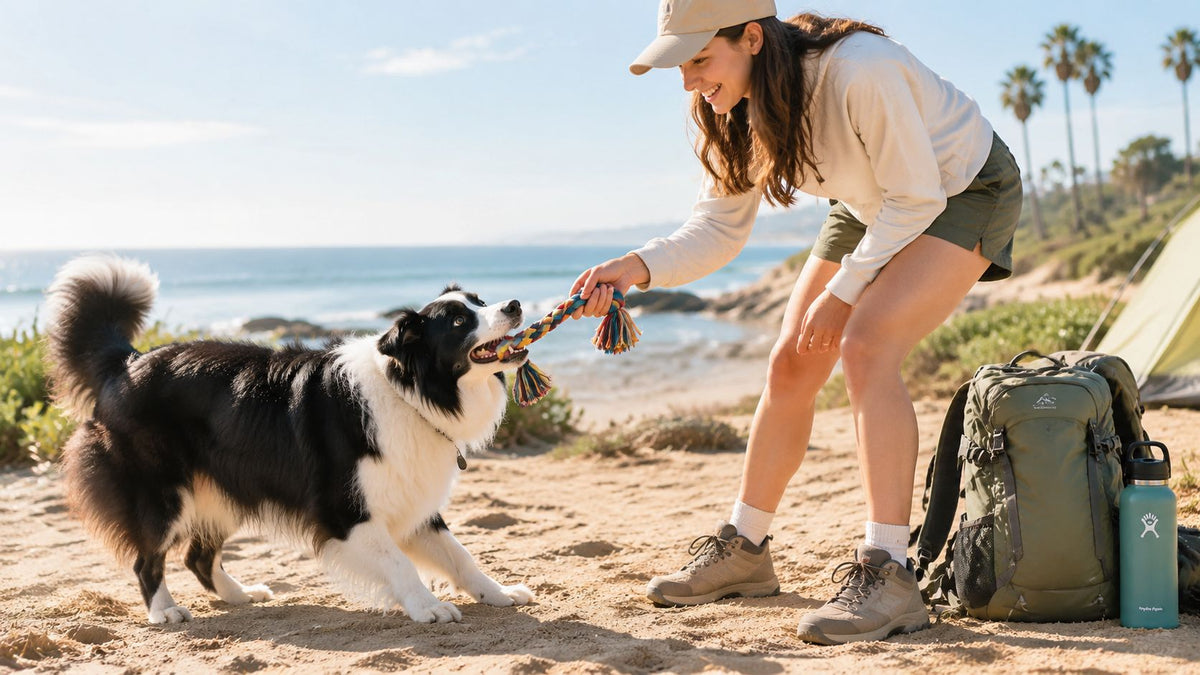
You're standing at a holiday park counter with a wet dog, a sandy towel, and a cheap rope toy in your hand because the general store had one rack and you needed something fast. The dog's already pulled the first knot apart, and now you're deciding whether this is a five-minute distraction or the sort of toy that earns a permanent place in the basket. That's the rope-toy decision most owners make, and it's worth taking seriously.
Dog rope toys sit in a funny middle ground. They're not plush, they're not rubber, and they're definitely not a leave-it-on-the-floor-for-days chew. Used properly, they're useful, versatile, and easy to pack. Used lazily, they turn into frayed fibre and a vet visit.
Table of Contents
- Why Dog Rope Toys Deserve a Second Look
- What Dog Rope Toys Are Actually Made Of
- Benefits That Make Rope Toys Worth Considering
- The Risks Every Owner Should Take Seriously
- How to Compare Rope Toys Before You Buy
- Travel-Friendly Rope Toy Ideas for Aussie Trips
- Cleaning and Supervision That Keep Play Safe
- Deciding If a Rope Toy Belongs in Your Dog's Kit
Why Dog Rope Toys Deserve a Second Look
A rope toy looks like a cheap grab-and-go purchase at a coastal caravan park, until a Border Collie turns it into a serious tug session and the owner has to decide whether it stays in rotation or gets binned after one rough play. Rope toys earn attention because they can work as compact, travel-friendly enrichment gear, but only when you treat them as supervised play items. Leave them out as everyday chew toys and they fray fast.
Australia has enough dog owners to keep this category relevant. Independent pet-ownership data says Australia had about 4.2 million pet dogs in 2013, dogs lived in 39% of households, and there were an estimated 19 dogs per 100 people. Animal Medicines Australia also reported more than 25 million pets nationwide and nearly 5 million pet-owning households in a population of 7.6 million households. That buyer base explains why rope toys keep showing up in pet shops, caravan stores, and online listings. 6Wresearch Australia pet toys market report
Rope toys belong to a different category
Rope toys play differently from rubber bones or plush toys. They suit tug, fetch, and short supervised chew sessions. They do not belong in the “leave it lying around” pile. That is especially true in Australia, where plenty of owners want something packable for weekends away, beach trips, and quick yard play, while still avoiding the flimsy imported options that look fine online and fall apart in a dog's mouth.
The broader dog toy market here is estimated at AUD 380 million to 450 million at retail in 2026, with rope tug toys making up about 5% to 8% of unit volume in that market. The broader category is also growing 4% to 6% annually, which shows rope toys are a small but steady slice of pet spending. Buyers treat them as practical enrichment gear, not as a once-and-done chew. IndexBox Australia dog toys market analysis
Practical rule: if you would not trust the toy after one hard tug session, keep it in supervised play only.
What Dog Rope Toys Are Actually Made Of
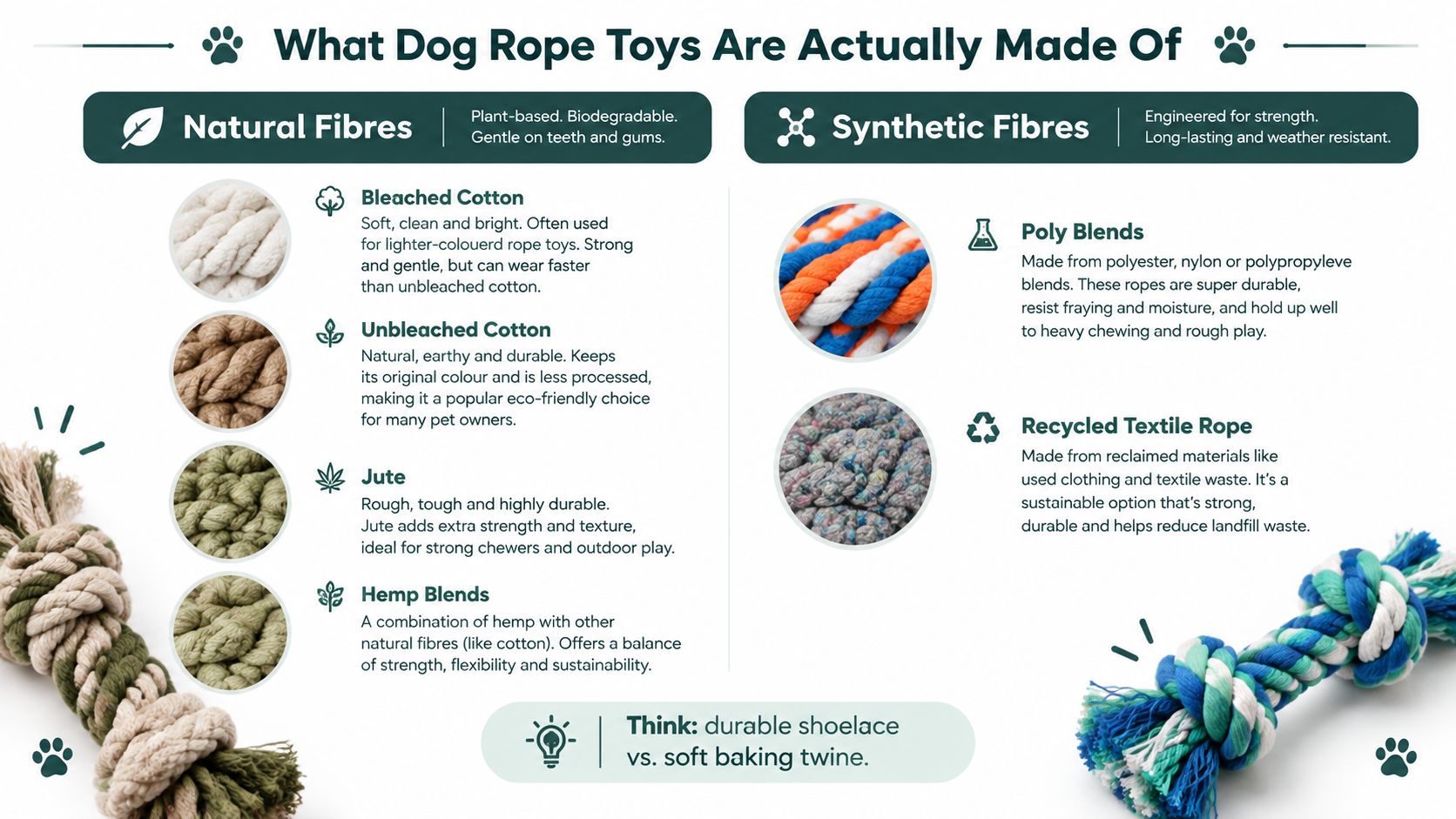
The material label matters, but construction matters just as much. A rope toy made from bleached cotton behaves differently from one made from hemp blends or synthetic poly blends, and the difference shows up fast when a dog starts chewing with intent. Natural fibres usually read cleaner in hand and on inspection, while mixed synthetics can hide thin spots until they fail.
A twisted single rope is easier to pull apart strand by strand, while a braided or knotted build spreads stress across more surface area. That doesn't make it indestructible, it just makes the toy more forgiving during tug.
What to look for in photos
Product photos tell you a lot before the toy ever arrives. Frayed edges in the listing photo usually mean the toy has already been handled roughly, or the seller is showing wear because the construction can't hide it. Inconsistent weave, mixed fibres, and vague dye claims are all reasons to keep scrolling.
Hardware is another weak point. Stainless steel rings usually outlast the rope around them, while plastic clips and hollow attachments tend to fail first. If a toy has a ball or ring, the connection point is usually where the trouble starts, not the centre of the rope itself.
Buying note: if the listing can't show the whole toy clearly, don't assume the missing section is the part that matters least.
QuietChew Bone Toy – Soft Bone Dog Toy is a useful contrast here because it's built as a soft bone for quiet play, with a bouclé bone shape in Charcoal or Milk. It's listed for indoor play and supervise use, which is the right framing for any toy that isn't meant to be an indestructible chew.
Benefits That Make Rope Toys Worth Considering
A rope toy earns a place in the basket when you use it for supervised chewing, not all-day gnawing. The braided fibres can create a floss-like action as the dog works the toy, which may help wipe surface plaque from teeth. That helps, but it does not replace veterinary dental care.
Tug is the other clear win. Rope flexes under load, so it cushions the pull better than a stick or a rigid toy. In active play, that gives the dog's teeth and your hands a little more forgiveness each time the toy shifts.
Travel is where rope toys pull their weight. They pack flat, barely take up space, and are easy to throw in a bag for motel rooms, cabin stays, ferries, or long drives. They also suit rotation, which is why they sit in so many Australian dog baskets across small and large breeds. The broader pet market is active, and rope toys fit the way owners use them, for tug, fetch, and short bursts of engagement. IndexBox Australia dog toys market analysis
Rope Toy Benefits at a Glance
| Benefit | Best For | Limits |
|---|---|---|
| Dental-style chewing | Dogs that mouth the toy under supervision | Not a dental substitute |
| Tug play | Dogs that like handler interaction | Not for unsupervised chewing |
| Travel distraction | Trips, cabins, ferries, and car breaks | Needs a dry spare and inspection |
The best rope toys earn their keep by doing one of those jobs cleanly. If a toy only looks fine because the dog barely touched it, it is weak, not durable.
The Risks Every Owner Should Take Seriously
Rope toys are supervised enrichment, not chew-anytime products. Once a dog starts shredding the fibres and swallowing them, the risk changes fast. Australian veterinary guidance warns that swallowed strands can form a linear foreign body in the gastrointestinal tract, which can plicate the intestine, cause perforation, and require emergency surgery. Source
A staffy that tears through a rope in 40 minutes is not an outlier, it's the warning sign. Some dogs don't nibble rope, they dismantle it. Once you've seen that style of play, you stop treating rope like a durable chew and start treating it like a supervised training object.
The failure points owners ignore
Dental wear is one issue, especially with hard, repetitive tugging. Small breeds can also get jaw strain if the toy is too heavy or awkwardly shaped. Loose knots can cause choking, and dye transfer can show up on light coats or damp paws if the colouring is poor.
The highest-risk dogs are heavy-power chewers, strong tuggers who pull until the toy gives, and smaller dogs that can get the whole toy too deep into the mouth. For those dogs, rope should be a short-session toy only, if it belongs in the house at all.
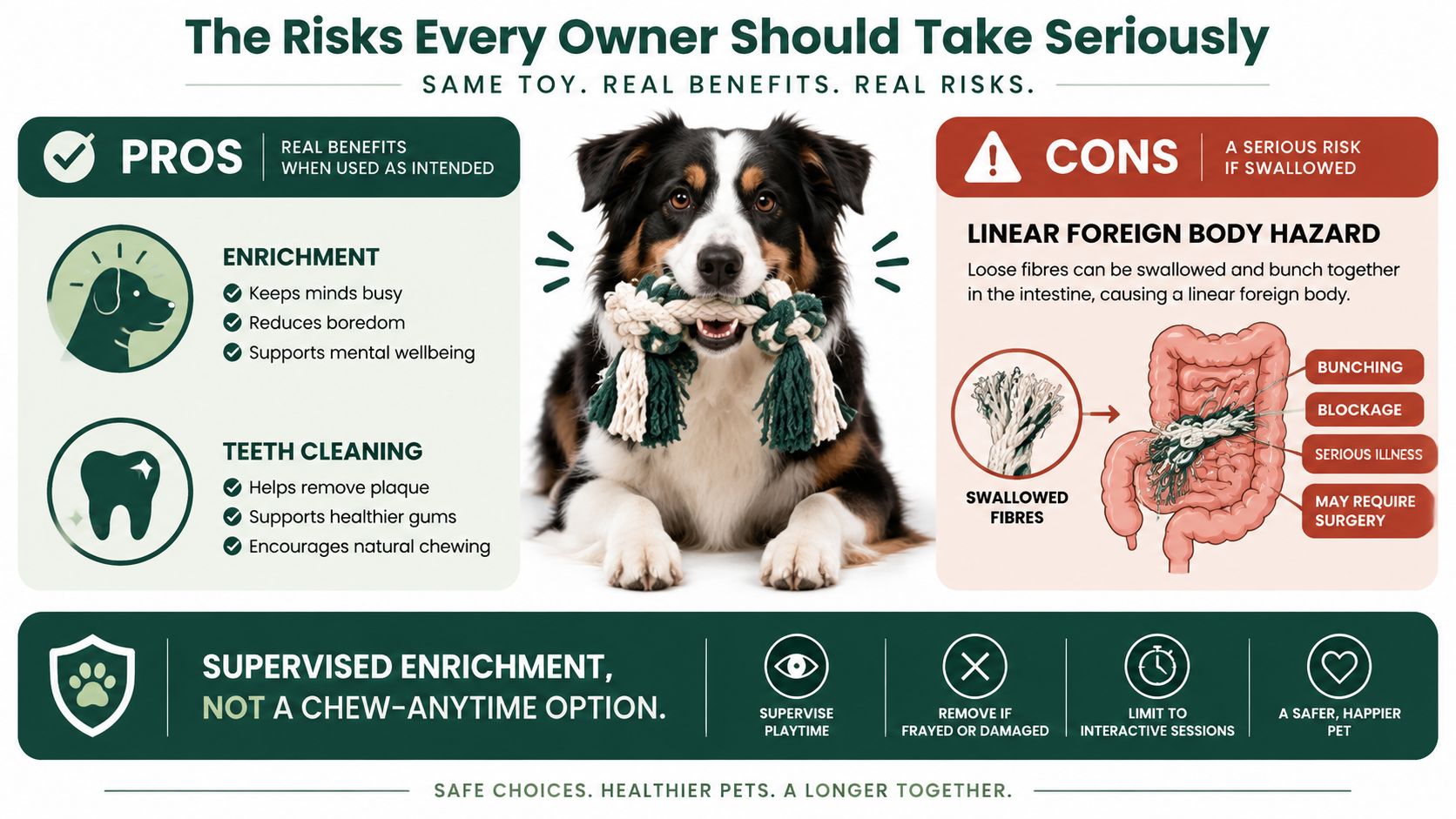
Remove a rope toy immediately if you see frayed ends, exposed inner fibres, missing chunks, or any piece small enough to disappear into the dog's mouth. If the toy is already losing shape, it's done. Don't wait for proof that it's unsafe, because the proof usually arrives at the vet clinic.
How to Compare Rope Toys Before You Buy
Start with fibre type. Natural cotton and hemp are easier to inspect, and untreated fibres are usually simpler to read visually when they begin to wear. Synthetic blends can be fine for supervised tug, but they're the kind of thing you buy with your eyes open, not because the listing looked tough.
Then look at the construction. A twisted rope is simple and cheap, a braided build spreads stress better, and a woven mat style usually gives more surface to grab. That doesn't automatically mean more durability, but it does tell you how the toy will fail when the dog starts pulling hard.
The four checks I actually use
- Fibre clarity: If the listing hides the fibre blend or uses vague wording, I pass.
- Join quality: Stitched knots are better than glued joins, because glue can peel under repeated tug.
- Attachment safety: Any ball or ring should be solid and cleanly joined, not hollow plastic that flexes oddly.
- Sizing: The toy should clear the muzzle by a few centimetres and still give the dog enough length to grip behind the back molars without crowding the face.
Product photos should also show even dye, consistent thickness, and the full toy with no mystery crop lines. If a seller won't show weight, size, or the hardware close-up, I assume they know the toy wouldn't look good under scrutiny.
Fur & Far's own product standards page is worth a look if you want to compare how a retailer frames materials, construction, and care before buying: product standards. That doesn't replace your own inspection, but it gives you a cleaner baseline than a random marketplace listing.
Rope Toy Construction at a Glance
| Build Style | Typical Fibre | Durability | Best Suited To |
|---|---|---|---|
| Twisted rope | Cotton or synthetic blend | Moderate | Light tug and quick sessions |
| Braided rope | Cotton, hemp, or mixed fibres | Better | Interactive play with supervision |
| Woven mat style | Textile blends | Variable | Dogs that like broad gripping surfaces |
TrailPack Walk Bag – Dog Walking Bag with Collapsible Bowl fits this buying mindset because it keeps treats, bags, and a bowl in one pouch, with a folding bowl and a waterproof liner you can pull out to rinse. It's not a rope toy, obviously, but it's the sort of walk-time gear that makes supervised play easier to manage on the move.
Travel-Friendly Rope Toy Ideas for Aussie Trips
A rope toy earns its space when it fits in a daypack beside a water bottle. If it doesn't pack that small, it's not really a travel toy, it's dead weight. On road trips, cabin stays, and ferry crossings, you want something that buys calm without taking over the bag.
For a cabin stay, I'd pick a small braided tug, because it gives you a short indoor game without taking up much room. For a backyard afternoon at a holiday park, a thicker woven rope is better, since it gives the dog a more satisfying grip and you're usually outside anyway. For tent-friendly fetch, a hemp loop works well because it's simple, light, and easy to spot on the ground.
The packing habit that saves hassle
Wet rope is a problem in humid boots, tents, and soft bags. If you're coming back from a beach stop at places like Cable Beach or Noosa, swap the wet rope out for a dry spare and let the used one air before you store it. Rope also doubles as a rough towel-dryer, which is handy after a quick rinse, but that only works if you've got a second toy waiting.
Pack two ropes per dog. One is in play, one is drying or waiting for inspection.
That habit keeps mould risk down and stops you from relying on a damp toy just because it's the only one you brought. It also gives you a backup when the first rope starts to fray or collect grit.
For broader trip planning around pet gear and routines, Fur & Far's travel guidance is useful background: travelling Australia with pets. The practical point is simple. Rope toys work on the road when you treat them like a consumable piece of travel enrichment, not a permanent chew.
Cleaning and Supervision That Keep Play Safe
The clean-up routine should be boring and automatic. Shake off sand and grass, rinse the rope under warm water, then machine-wash it in a mesh laundry bag with pet-safe detergent. After that, air-dry it fully in sunlight, because a damp rope is a bacterial nuisance waiting to happen.
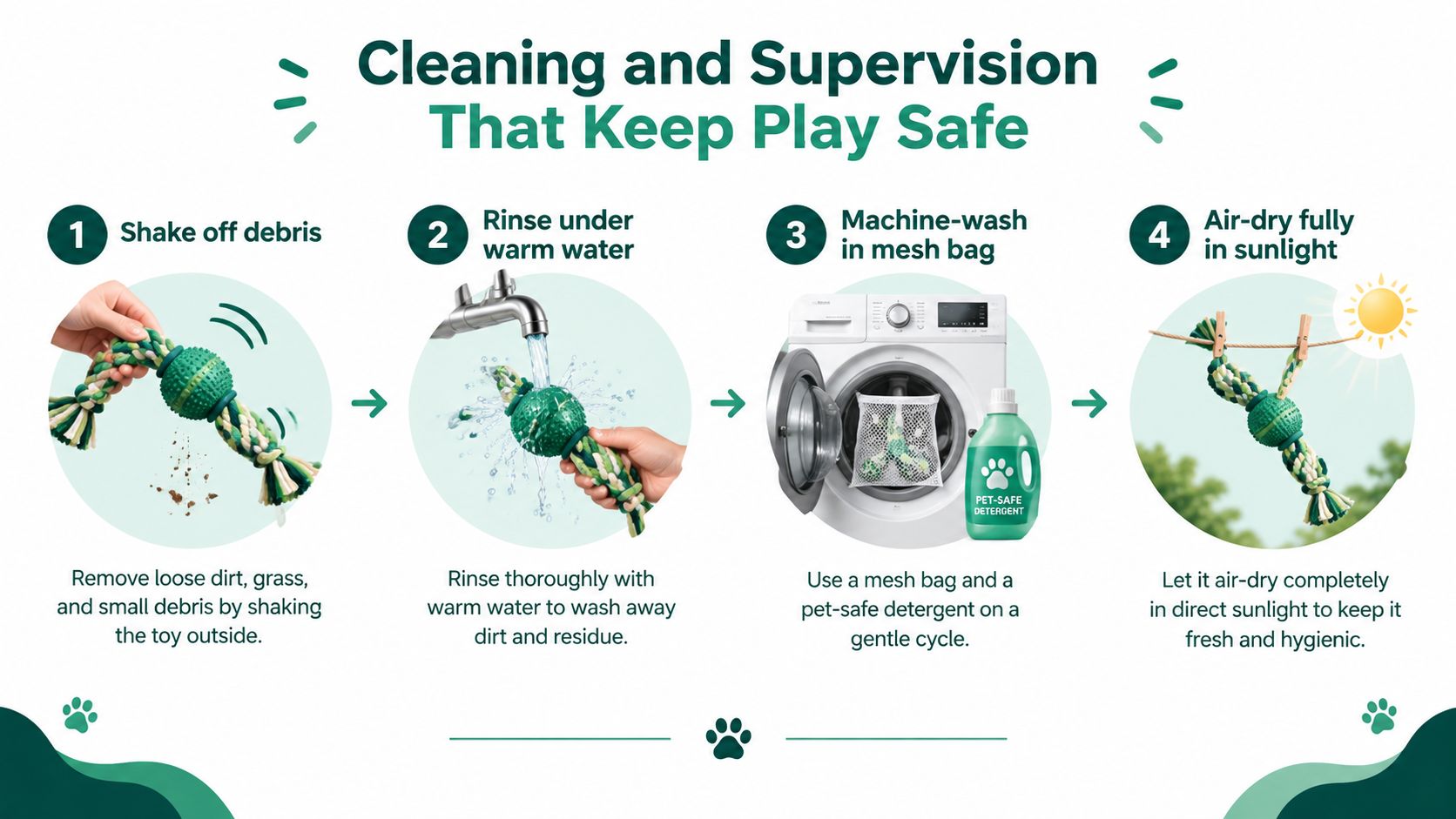
Inspect the whole length before the next session. I mean every centimetre, not just the ends. Look for fraying, loose threads, colour transfer on a damp cloth, and any spot where the rope has gone thin enough to lose its original feel.
My supervision routine
- Start with the mouth test: If the toy fits inside the dog's mouth whole, it's too small.
- Check for dye rub: Wipe it with a damp cloth and stop if colour comes off.
- Watch the first minute: The opening seconds tell you whether the dog is tugging or trying to rip fibres free.
Use a three strikes rule. If a rope has three frayed spots, or if the rope has clearly reduced in thickness, bin it. Don't stretch the life of a toy just because it still looks familiar. In coastal parts of Australia, humidity slows drying and makes mildew more likely if you store rope damp, so the fast-dry habit isn't optional.
Fur & Far's care notes are the right place to check if you want a retailer's maintenance guidance before you wash anything you bought: product care guide. The goal here is simple, keep the rope clean enough to use, but not so worn that you're gambling with a swallowed strand.
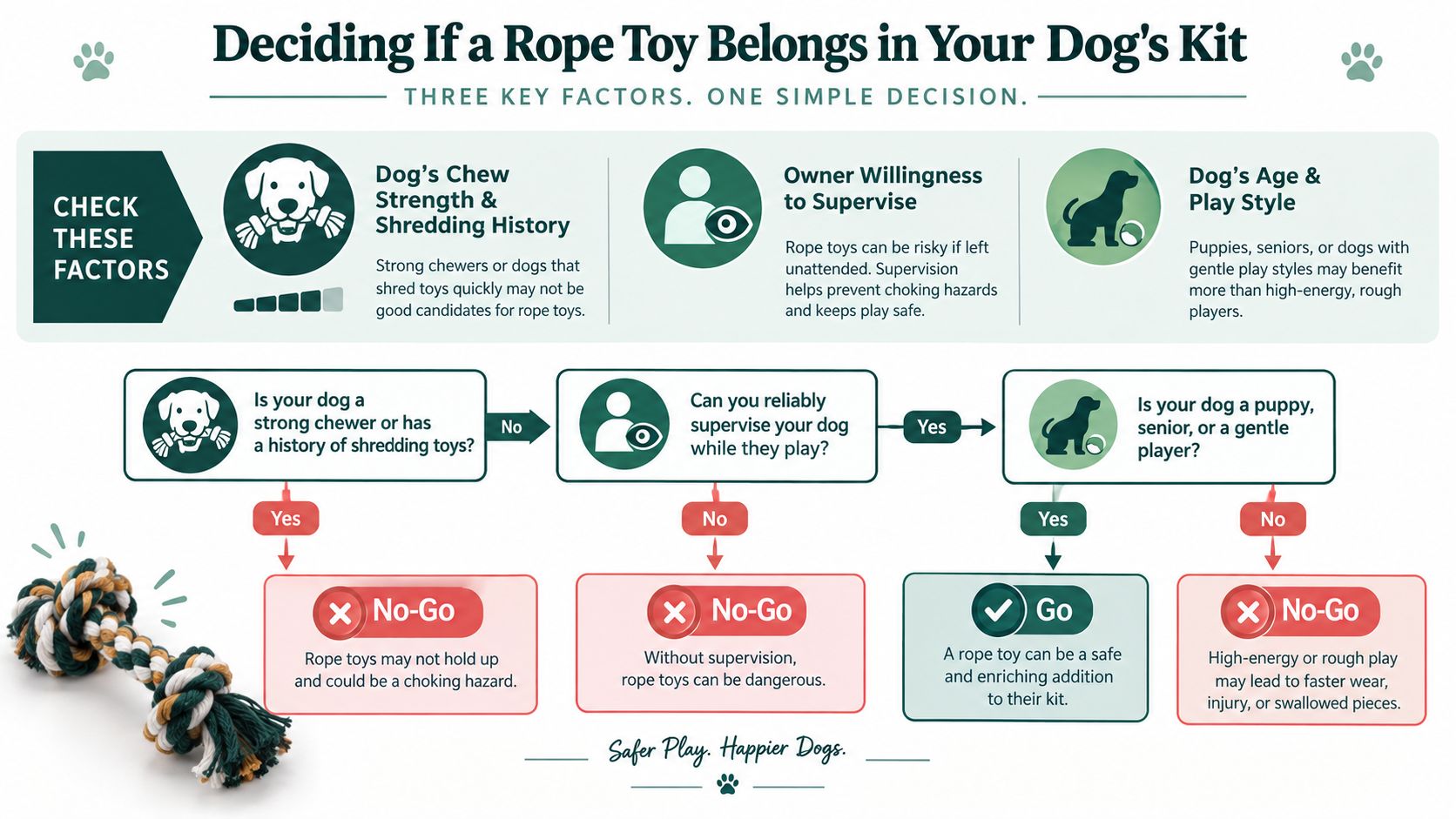
Deciding If a Rope Toy Belongs in Your Dog's Kit
Use three filters. First, think about your dog's chew strength and shredding history. If the dog demolishes soft toys quickly or treats every rope like a puzzle to be solved, you already know where this is heading.
Second, be honest about supervision. If you won't watch every session, rope toys are the wrong category. Third, match the toy to a real use case, such as tug games, crate distraction while you're in the room, or short travel settling after a walk.
Rope toys make sense for dogs that play with a partner, need a soft-mouthed fetch option, or enjoy gentle floss-style chewing under your eye. They don't make sense for power chewers left alone, or for puppies still in heavy teething who'll shred anything with threads. The line is simple.
If you wouldn't leave it on the floor for ten minutes without checking it, it's not the right rope toy for that dog.
My take is blunt. Rope toys are worthwhile, but only conditionally. Buy them for the dog in front of you, not for the label on the box, and don't confuse supervised enrichment with a safe all-day chew.
If you want practical pet gear that suits travel and everyday care, browse Fur & Far for functional accessories and plan the next rope-toy purchase around your dog's actual play style, not the cheapest listing you can find.
Created with Outrank tool