
Why Premium Pet Gear Lasts Longer: A 2026 Guide
Table of Contents
- The Material Science Behind Premium Pet Gear That Lasts
- Lifecycle Cost Analysis: Why Cheap Gear Costs More
- Stress-Test Methodology: How We Assess Durability
- Choosing a Durable Dog Harness in Australia: What to Look For
- How to Maintain Pet Accessories for Long-Term Performance
- Repairability vs. Replacement: The Sustainability Argument
- Conclusion: Investing in Gear That Goes the Distance
- Frequently Asked Questions
Last Updated: September 13, 2026
The Material Science Behind Premium Pet Gear That Lasts
Premium pet gear lasts longer because its materials resist the specific forces that destroy cheap alternatives: abrasion, tensile stress, UV degradation and moisture. This guide from Fur & Far breaks down the engineering behind gear that survives years of daily use, and why so much of it comes down to what happens at the fibre level.
Material density is the first dividing line. Full-grain leather keeps the hide's tightest fibre structure intact, which is why it resists cracking far better than split leather or bonded synthetics. Nylon webbing behaves differently: its tensile strength comes from how tightly the yarns are woven, not just the thickness of the strap.
Then there's UV degradation. Cheap dyes and coatings break down under harsh sun, fading and weakening within a season. Higher-grade gear uses UV-stabilised treatments that hold their structure through years of outdoor exposure.
Australian Competition and Consumer Commission product safety guidance notes that consumers are entitled to expect durability consistent with price and stated purpose, which is worth remembering when a bargain strap fails months in.
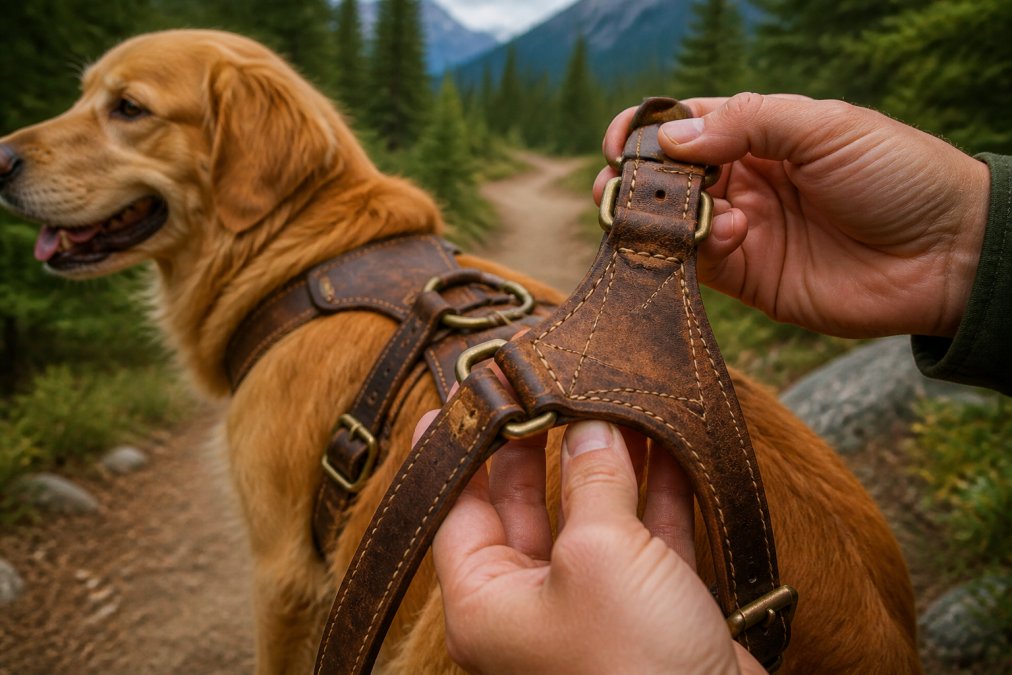
Full-Grain Leather vs. Synthetic Substitutes
Full-grain leather develops a patina and holds its shape for years; bonded synthetics delaminate and fray. The difference shows up in material density and how the fibres interlock. Leather also breathes, which matters for comfort padding on longer walks.
Synthetics aren't automatically inferior. High-performance materials like coated 600D Oxford offer excellent abrasion resistance and dry fast. The failure point is usually the coating, not the weave.
Reinforced Stitching and Hardware Integrity
Reinforced stitching at stress points is what separates a harness that lasts from one that splits at the D-ring. Look for box-X patterns rather than single lines. Hardware integrity matters just as much: cheap buckle failure is one of the most common causes of gear replacement, and it usually happens at the worst possible moment.
Lifecycle Cost Analysis: Why Cheap Gear Costs More
"Buy cheap, buy twice" is a cliché because it is usually true, but the maths is more interesting than the slogan. Lifecycle cost analysis compares the total cost of ownership over a defined period, not the sticker price at the till. Once you run the numbers, the premium option wins far more often than the price gap suggests.
How to calculate cost-per-use
The formula is simple:
Cost-per-use = (purchase price + maintenance costs − resale value) ÷ number of uses
The variable that does the heavy lifting is number of uses, and that is where budget gear collapses. A lead that fails after six months might deliver 180 walks. A lead that lasts three years delivers around 1,080. Even at a higher upfront price, the longer-lived product spreads its cost across six times as many outings.
A worked comparison
Assume a daily walker, roughly 360 outings a year. Figures below are illustrative, not quoted prices, and are shown in Australian dollars.
| Gear type | Budget option | Premium option |
|---|---|---|
| Lead | $20, replaced ~3× per year | $60, lasts ~3 years |
| Harness | $30, replaced ~3× per year | $90, lasts ~3 years |
| Walk bag | $25, replaced ~3× per year | $75, lasts ~3 years |
Over three years:

- Budget lead: $20 × 3 × 3 = $180
- Premium lead: $60 × 1 = $60
- Budget harness: $30 × 3 × 3 = $270
- Premium harness: $90 × 1 = $90
- Budget walk bag: $25 × 3 × 3 = $225
- Premium walk bag: $75 × 1 = $75
Total three-year spend: $675 on budget gear versus $225 on premium, a difference of $450, before counting the time and hassle of three separate replacement cycles.
Cost-per-use tells the same story. The budget lead works out to roughly $0.33 per walk; the premium lead to about $0.06. The premium harness lands near $0.08 per walk against roughly $0.25 for the budget version.
The hidden costs the table misses
Sticker price is only part of the picture. Three costs rarely make it into a comparison:
- Replacement friction, the time spent researching, ordering, and waiting for a replacement, plus the risk of a failure mid-walk.
- Safety incidents, a buckle that fails under load can mean a loose dog near traffic. That cost is not financial, but it is real.
- Residual value, well-made leather and hardware often hold resale or hand-me-down value; bonded synthetics typically do not.
When premium is not worth it
Honesty matters here. Premium gear is a poor investment if:
- The dog is a puppy and will outgrow the item within months.
- The gear is used a handful of times a year rather than daily.
- The item is a fashion accessory where function is secondary.
In those cases, a mid-range option is the rational buy. The lifecycle argument only holds when usage volume is high enough to amortise the upfront cost.
The investment framing
This is the value proposition most buyers miss. The upfront saving feels good until the third replacement. The maths favours the investment piece every time, provided the gear genuinely lasts, which is why checking construction and load ratings matters as much as checking the price tag.
Stress-Test Methodology: How We Assess Durability
Most gear reviews tell you a harness "feels sturdy." Durability is measurable, and the difference between premium and budget gear shows up when you replicate the forces a walk actually generates. Here is how serious testing works, and what to look for on a spec sheet.
The four forces that kill pet gear
Every failure traces back to one of four mechanisms:
- Tensile overload, a sudden spike in pull force, such as a dog lunging at a cyclist.
- Abrasion, sustained friction against concrete, gravel, or brush.
- UV degradation, cumulative breakdown of polymer chains from sunlight.
- Fatigue, thousands of small load cycles that crack metal and fray thread.
A product can pass one and fail another. A strap with excellent tensile strength can still snap at the buckle if the stitching fatigues.
Break strength vs. working load
Break strength is the force at which a component fails completely. Working load is the safe operating limit, and it is always a fraction of break strength. The ratio between them is the safety factor.
A common pattern in load-rated climbing and rigging hardware is a safety factor of roughly 5:1, meaning a component rated to 1,000 kg break strength has a working load around 200 kg. Pet gear is not regulated to the same standard, but the principle holds: if a manufacturer only quotes break strength and never a working load, treat the number with caution.
For context, a medium dog trotting on a lead generates modest force, but a sudden lunge can multiply that several times over. A harness rated only for the dog's standing weight has no margin for that spike.
How the tests actually run
- Tensile pull test, the strap or D-ring is clamped and pulled at a controlled rate until failure. The peak force is recorded. This is the number that should appear on a spec sheet.
- Abrasion test, webbing is dragged under load across a standard abrasive surface for a set number of cycles, then re-tested for tensile strength. The percentage of strength retained is the real durability signal.
- Buckle cycle test, a clip is opened and closed repeatedly (often into the thousands) to expose spring fatigue and plastic cracking before it happens in the field.
- Salt-spray corrosion test, hardware is exposed to a saline mist for a set period to simulate coastal conditions. Plated zinc fails fast; stainless and properly coated alloys survive.
- UV chamber exposure, samples sit under controlled UV for hundreds of hours to mimic years of sun. Cheap dyes fade and webbing embrittles; UV-stabilised polymers retain tensile strength.
What this means when you buy
You will rarely see full test data on a retail page. What you can do is look for the signals that testing happened: a stated load rating, hardware from a named manufacturer, stitching described by pattern (box-X, bar-tack), and materials named by denier and coating rather than vague adjectives.
Australian Competition and Consumer Commission product safety guidance notes that consumers are entitled to expect durability consistent with price and stated purpose, a useful lens when a product's claims outrun its spec sheet.
Choosing a Durable Dog Harness in Australia: What to Look For
A durable dog harness Australia buyers can rely on needs four things: a stated load rating, reinforced stitching, corrosion-resistant hardware and padding that doesn't compress flat. Fit matters as much as build. A harness that rubs will fail early regardless of how well it's made.
For everyday walks, Fur & Far's TrailGrip Heavy-Duty Dog Lead pairs a padded grip with nylon webbing built for bigger dogs, available in three sizes. Pair it with a harness that distributes load across the chest rather than the throat.

Ergonomic design isn't marketing language. A well-shaped harness spreads pressure, which reduces wear and tear on both the gear and the dog.
Load-Bearing Capacity and Break Strength Explained
Load-bearing capacity is the weight a piece of gear can hold safely during normal use. Break strength is the point at which it fails entirely. Never operate near break strength; a sensible safety margin keeps working load well below it.
For a larger dog, look for hardware rated well above the animal's weight to absorb lunging force.
How to Maintain Pet Accessories for Long-Term Performance
Maintaining pet accessories comes down to cleaning, drying and inspecting, done consistently. Learning how to maintain pet accessories properly can double their working life.
- Rinse webbing after muddy walks and air-dry fully before storage
- Wipe leather with a damp cloth, then condition sparingly
- Check stitching at stress points monthly for fraying
- Test buckles and clips for stiffness or cracking
- Store gear dry, away from direct sun
Moisture-wicking padding should be washed according to the maker's instructions, since trapped sweat degrades foam over time. Fur & Far's BootGuard Cargo Mat wipes clean with a damp cloth, which keeps the PVC coating intact rather than scrubbing it away.

Repairability vs. Replacement: The Sustainability Argument
Repairability beats replacement on both cost and sustainability grounds. A harness with replaceable buckles or restitchable seams can be serviced rather than discarded, which keeps it out of landfill and saves money.
Better construction uses stitching you can replicate and hardware you can swap. That's quality craftsmanship in practice, not just a label.
The sustainability case is straightforward: the greenest gear is the gear you already own and keep using. Choosing repairable, durable items reduces the total number of products you buy.
Australian Government recycling and waste guidance outlines how textile and leather waste contributes to landfill, reinforcing why buying once and maintaining well matters.
Conclusion: Investing in Gear That Goes the Distance
Every cheap replacement adds up, and the gear that fails is usually the gear you trusted most. Fur & Far builds for the long haul, with ceramic bowls that stay put, a walk bag with a rinseable liner, and road trip essentials designed for real journeys. Free shipping applies on orders over $150.
Frequently Asked Questions
What materials make pet gear more durable?
Full-grain leather, 600D Oxford fabric with PVC coating, and heavy-duty nylon webbing are among the best materials for pet travel gear. These materials resist abrasion, UV degradation, and moisture, while reinforced stitching and corrosion-resistant hardware prevent premature failure. For example, the BootGuard Cargo Mat uses 600D Oxford with PVC coating, designed to handle muddy paws and repeated wiping without cracking.
Is it worth spending more on premium pet travel accessories?
Yes, when you consider cost-per-use. Premium gear also offers better safety features, like reflective visibility and load-bearing capacity, which matter for larger dogs or unpredictable situations.
How do I know if pet gear is high quality?
Look for specific indicators: dense stitching patterns (e.g., box-X stitching on load points), metal hardware that does not bend under pressure, and materials with a tight weave. Check for certifications or details about tensile strength and break strength.
How does regular wear and tear affect budget pet gear?
UV exposure can make synthetic fabrics brittle, while poor stitching unravels under stress. Over time, this can lead to buckle failure, tears, and reduced safety.
The real test of premium pet gear isn't the price tag, it's how many years of daily use it delivers before it needs replacing. Fur & Far curates travel and walking gear built around comfort, function and style, from cabin-ready carriers to boot mats and leads sized for larger dogs. Get started with Fur & Far and gear that's ready for every journey.