
Stylish Pet Gear for City Commuters: 2026 Guide
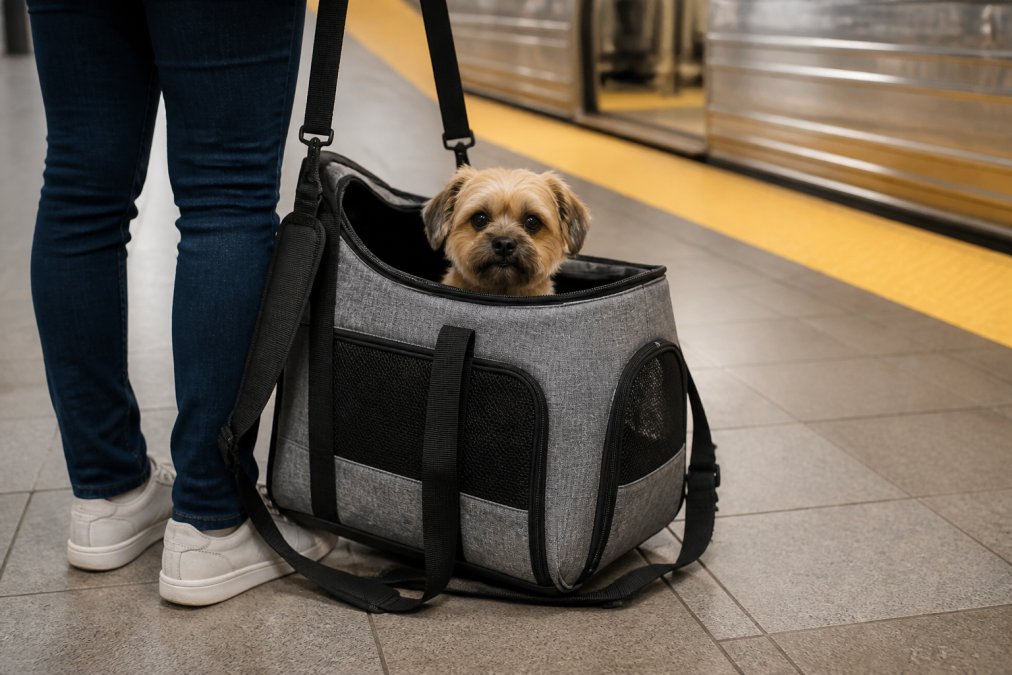
Table of Contents
- Lightweight Carriers for Daily Pet Travel
- How to Travel With a Pet on Public Transport
- Durable Dog Walking Gear for Urban Environments
- Safety in High-Traffic Urban Environments
- Ergonomics for the Human Commuter
- Sustainable and Eco-Friendly Materials
- Conclusion
- Frequently Asked Questions
Last Updated: September 11, 2026
Lightweight Carriers for Daily Pet Travel
Lightweight carriers for daily pet travel are soft-sided or framed carriers built to move a pet through a commute without bulk or strain. For city commuters, the deciding factors are packed dimensions, carry options, and fold-down speed.
This guide from Fur & Far covers the gear that earns its place on a daily commute: carriers, walking kit, and the safety details most buyers only consider after the first trip.
RollCabin Soft Carrier: Wheeled, Handheld, Cross-Body
The RollCabin Soft Carrier is a wheeled soft pet carrier that switches between rolling, handheld, and cross-body carry. It measures approximately 60 × 40 × 35 cm, carries up to 15 kg, and comes in Black, Pink, or Yellow at $133.00.
The wheels are the point: on a long platform walk or through a car park, rolling beats carrying. On stairs or gravel, the cross-body strap takes over.
A wheeled carrier still needs lifting somewhere, so check your pet's weight plus the carrier against your comfortable lift limit before you commit.
FoldDash Pet Stroller: One-Touch Fold for Busy Streets
The FoldDash Pet Stroller folds in a single motion on an aluminium frame, which matters when you are folding one-handed at a bus stop. It comes in Black, Grey, or Khaki at $220.00.
The limitation is honest: a stroller is a commitment to smooth surfaces. Cobblestones, tram tracks, and steep ramps all change how it handles. Weigh your pet against the frame rating before you roll.
How to Travel With a Pet on Public Transport
Travelling with a pet on public transport means keeping the animal contained, quiet, and out of other passengers' space. Most operators require a carrier or lead and restrict travel to off-peak windows, so check your network's rules first (transport.nsw.gov.au).
Pet travel on public transport is governed by a patchwork of state legislation, operator policies, and accessibility standards, not one national rule. A carrier approved on one network may be refused on another, usually over dimensions, containment, or whether the animal is classified as an assistance animal.
The regulatory layers you are actually dealing with
Three layers apply, and they do not always agree:
- State and territory animal welfare and transport legislation sets the baseline for where animals may be carried and under what containment. This is the layer that determines whether a pet is allowed on a service at all.
- Operator conditions of carriage add the detail: maximum carrier dimensions, peak-hour bans, whether the pet must be in a closed carrier for the entire journey, and whether a ticket is required for the animal.
- Disability discrimination and assistance animal provisions create a separate, stronger right of access for guide dogs, hearing dogs, and other accredited assistance animals. Those animals are not pets for the purposes of carriage, and the rules that apply to your cat in a backpack do not apply to them.
Commuters often assume operator policy is the whole story, but disputes are usually decided by state legislation and conditions of carriage, not a staff member's judgement on the day.
What to check before your first trip
Work through this list for your specific network:
- Carrier dimensions. Most urban rail and bus operators publish a maximum length, width, and height for pet carriers. Measure your carrier packed, not empty, because soft-sided carriers bulge once the animal is inside.
- Containment type. Some networks accept a lead and muzzle for dogs; most require a closed carrier for cats and small animals. A few require the carrier to be closed for the entire journey, including on platforms.
- Peak restrictions. Many operators ban pets during defined peak windows on weekdays. The windows vary by network, so check the current timetable rather than assuming a standard morning and evening block.
- Ticketing. Some networks carry pets free; others require a child or concession ticket. This is rarely enforced consistently, but it is enforceable.
- Assistance animal accreditation. If you rely on an assistance animal, carry the accreditation documentation your state or territory recognises. Operator staff are entitled to ask for it.
Etiquette that keeps access open
Etiquette is not optional. A calm, contained pet on a train is tolerated; a loose one gets commuters complaining to the operator, and that is how restrictions tighten for everyone.
The behaviours that matter are unglamorous: keep the carrier closed on seats and platforms, board at the quieter end where possible, bring waste bags and a folded bowl for delays, and keep your pet's registration details on your phone. Avoid peak windows in the first month while you build the habit.
If you are unsure whether your setup complies, the operator's conditions of carriage is the authoritative source, usually published on their website. Read it before you travel rather than arguing it at the gate.
For guidance on waste and pet ownership responsibilities, see your local council's pet owner information, and for product safety expectations, the ACCC product safety guidance sets out what Australian sellers must meet.
Durable Dog Walking Gear for Urban Environments
Durable dog walking gear for urban environments survives pavement, kerbs, tram tracks, and constant clipping and unclipping. City walking wears gear differently to park walking: more abrasion, more stops, more short corrections on a lead.
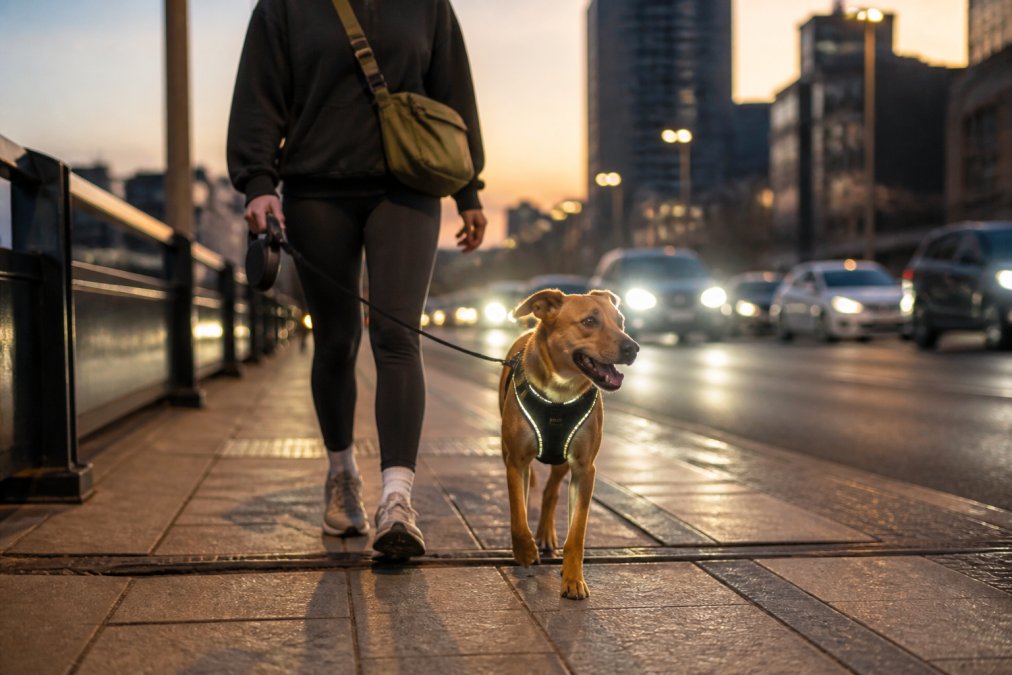
Evening walks are where most city gear falls short. Dim footpaths, cyclists, and cars pulling out of driveways all reduce how quickly a driver sees your dog.
GlowTrail LED Harness and ReachLock Lead for Evening Walks
The GlowTrail LED Dog Harness puts light on the dog rather than on you. It comes in sizes S to XL at $65.00, and you measure chest rather than weight to size it.
Pair it with the ReachLock Retractable Dog Lead, which has a lock-and-release brake, comes in 3 m or 5 m, and costs $56.00 as a single lead or as a lead-and-collar set.
Be straight about the ReachLock: it is not built for heavy pullers or for bike work. If your dog lunges, a fixed lead is the safer choice.
TrailPack Walk Bag and TrailBag Dispenser for Everyday Carry
The TrailPack Walk Bag holds treats, bags, and a folding bowl in one 600D Oxford pouch with a removable, rinseable waterproof liner. It is $65.00 in Grey on this listing.
The TrailBag Waste Bag Dispenser covers the other half of the walk: HDPE rolls, named packs rather than letter codes, with a dispenser on selected packs, from $44.00. These are landfill bags, not flushable.
For a full kit list, the DualMode Walk Lead at $24.00 is the value pick. It adjusts between Skinny and Thick, has waterproof webbing, and carries a D-ring for a bag dispenser.
| Item | Price | Best For | Key Detail |
|---|---|---|---|
| RollCabin Soft Carrier | $133.00 | Terminals and car parks | Wheeled, cross-body, up to 15 kg |
| FoldDash Pet Stroller | $220.00 | Smooth city surfaces | One-touch fold, aluminium frame |
| GlowTrail LED Harness | $65.00 | Dusk and dawn walks | Sizes S-XL, measure chest |
| ReachLock Retractable Lead | $56.00 | Controlled reach on walks | 3 m or 5 m, lock brake |
| TrailPack Walk Bag | $65.00 | Everyday carry | Folding bowl, waterproof liner |
| TrailBag Waste Bags | $44.00 | Clean-up on the go | HDPE, dispenser on selected packs |
| DualMode Walk Lead | $24.00 | Budget daily walking | Waterproof, D-ring |
Safety in High-Traffic Urban Environments
Safety in high-traffic urban environments comes down to visibility and control, in that order. A driver who sees your dog half a second earlier has half a second more to stop.

High-visibility gear is not a fashion choice in a city. LED harnesses, reflective piping, and light-coloured carriers all raise how early you are seen. So does walking on the side of the footpath facing traffic where there is no barrier.
The second half is control. A retractable lead gives your dog reach, exactly what you do not want near a road with poor sightlines. Shorten the lead at every kerb, and use the lock function rather than your grip.
Ergonomics for the Human Commuter
Ergonomics for the human commuter is the part almost every pet gear guide skips. You are the one carrying, lifting, and folding, often on a timetable, and the gear that looks best in a product photo is not always what protects your shoulders, lower back, and grip over a full commute.
The weight that matters is not your pet's weight but your pet plus the carrier plus whatever else you are carrying. A 7 kg dog in a carrier with a laptop bag is a different job to a 7 kg dog alone, and the difference shows up in your posture long before your pet's comfort.
How load position changes what your body does
Carrying a pet is a load-carrying problem, and the load's position determines which muscles pay for it:
- One-hand carry at your side. The load hangs away from your centre of mass, so your spine leans away from it to counterbalance. Over a long walk this loads one side of your lower back and one shoulder. It is the least efficient option for anything beyond a short platform walk.
- Cross-body carry. The strap crosses your torso and brings the load closer to your centre of mass, which reduces the counter-lean. It distributes pressure across the opposite shoulder and hip rather than concentrating it on one side. This is the single biggest improvement most commuters can make.
- Backpack carry. The load sits high and close to your spine, which is the most efficient position for walking. The trade-off is that a pet carrier worn as a backpack puts the animal behind you, where you cannot see or reassure it, and where it is exposed to knocks from other passengers.
- Rolling. Wheels remove the load from your body entirely, which is why they win on long platform walks and through car parks. The catch is that a wheeled carrier still has to be lifted at stairs, kerbs, and vehicle steps, so the lift weight, not the rolling weight, is the number to check.
The numbers to check before you buy
The comfortable carry limit for a one-shoulder or one-hand load is well below the limit for a backpack or rolling load. Rather than quoting a single figure, use this method:
- Weigh your pet.
- Weigh the empty carrier.
- Add the weight of what you carry inside it: bowl, water, waste bags, and any treats.
- Add the weight of your other bag, because you will be carrying both.
- Compare that total against how long you can comfortably hold it at your side. If the answer is less than your commute, you need wheels or a backpack.
A carrier rated to 15 kg does not mean 15 kg is comfortable for you; it means the carrier will not fail at that weight. The gap between those claims is where most commuters get caught.
Adjustments that make a measurable difference
- Use cross-body carry rather than one hand for anything over a short walk. The strap should sit on the opposite shoulder to the side the carrier hangs on.
- Switch to wheels the moment your arm starts to tire, not after. Fatigue changes your gait, and a changed gait on a crowded platform is a trip risk.
- Keep the carrier packed light. Bowl, bags, and water only. Every extra item adds to the lift weight at every stair and vehicle step.
- Shorten the strap so the carrier sits at hip height, not below it. A carrier swinging at knee height pulls your shoulder down and catches on seats and other passengers.
- Alternate sides on the return leg if you are carrying cross-body, so the load is not always on the same shoulder.
Coming from a basic soft carrier, expect the first week with a wheeled or cross-body option to feel like a different commute. The change is not cosmetic; it is the difference between arriving able to work and arriving needing to sit down.
Sustainable and Eco-Friendly Materials
Sustainable and eco-friendly materials in pet gear are mostly about longevity and honest disposal, not marketing labels. Gear that lasts five years uses less material than gear replaced every season.
That is the argument for buying once. A 600D Oxford walk bag, waterproof webbing on a lead, and an aluminium frame on a stroller all extend service life. Repair and rinse beats replace.

Disposal matters too. The TrailBag rolls are HDPE landfill bags, and the listing says so plainly rather than implying they break down. Honest labelling on waste products is worth more than a green logo.
For guidance on waste and pet ownership responsibilities, see your local council's pet owner information, and for product safety expectations, the ACCC product safety guidance sets out what Australian sellers must meet.
Conclusion
The gap in most commuter setups is not style but the unglamorous details: how the carrier folds, whether the lead locks, and whether you can carry the whole thing for twenty minutes without your shoulder complaining.
Fur & Far builds for exactly that. The RollCabin Soft Carrier gives you wheels plus cross-body carry at $133.00, the FoldDash Pet Stroller folds in one motion at $220.00, and the GlowTrail LED Harness at $65.00 handles the evening walk. Free shipping applies on orders over $150.

Shop the Road Trip Essentials collection at Fur & Far and build a commute setup that works on the days it actually matters.
Frequently Asked Questions
What features should I look for in a pet carrier for public transport?
Look for a carrier that meets airline and train operator size limits, has breathable mesh panels for airflow, and offers multiple carry options such as handheld and cross-body. The RollCabin Soft Carrier measures approximately 60 x 40 x 35 cm and has a load rating up to 15 kg, making it suitable for smaller dogs and cats on daily commutes.
How do I keep my pet comfortable during a daily urban commute?
Start with a carrier your pet can stand and turn around in, and introduce it at home before the first trip. Bring a portable water bottle such as the FillSip and a collapsible bowl for breaks. Keep walks short and shaded on hot days, and avoid leaving a full water bottle in a hot car.
Are there stylish pet accessories that are also durable for city travel?
Yes. Look for waterproof, odour-resistant webbing on leads, such as the DualMode Walk Lead, and harnesses with high-visibility features like the GlowTrail LED Harness. A 600D Oxford walk bag with a waterproof liner, such as the TrailPack, handles daily wear and rinses clean after muddy walks.
How can I safely transport my pet on trains and buses?
Check the specific operator's rules before you travel, as policies vary by route and state. In general, keep your pet in a secure, breathable carrier for the whole journey, avoid peak-hour carriages where possible, and hold the carrier on your lap or place it on the floor between your feet rather than on a seat.