
How to Measure Your Dog for a Carrier
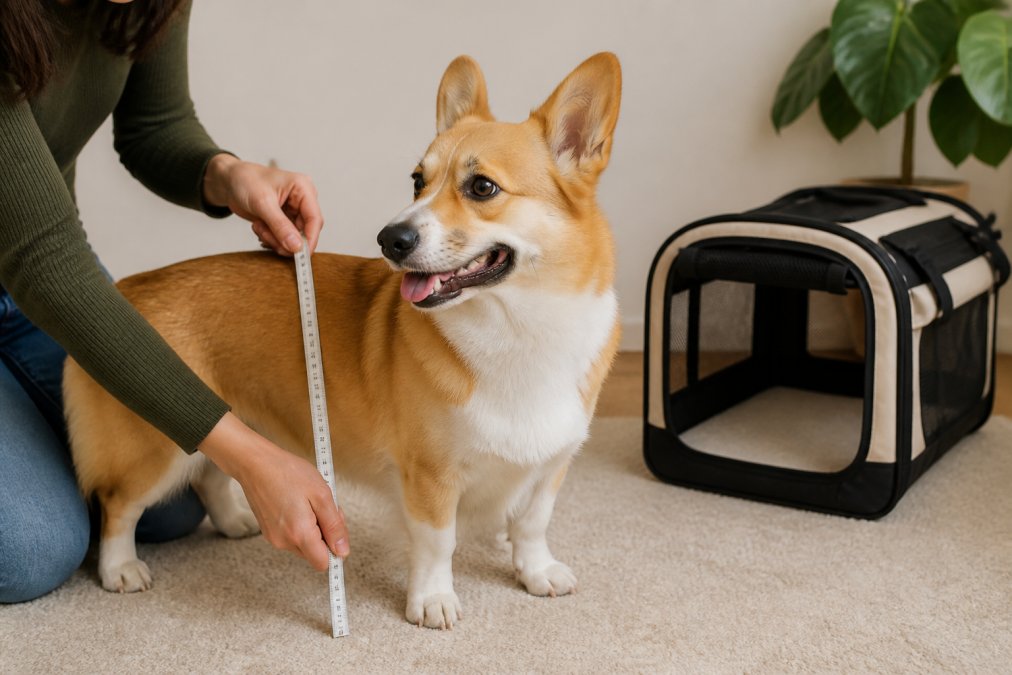
Table of Contents
- Why Accurate Measurement Matters Before Buying a Carrier
- What You'll Need to Measure Your Dog
- Step 1: Measure Body Length from Nose to Base of Tail
- Step 2: Measure Height from Ground to Shoulder
- Step 3: Measure Girth and Width for Comfort
- Airline Approved Pet Carrier Requirements and Dimensions
- How to Choose the Right Size Dog Carrier for Your Needs
- Dog Travel Safety Tips When Using Your Measured Carrier
- Frequently Asked Questions
Last Updated: September 25, 2026
Why Accurate Measurement Matters Before Buying a Carrier
Getting the right carrier size is the difference between a calm trip and a stressful one. When you measure dog for carrier properly, you avoid the common mistake of buying something too tight or too loose. A poorly fitted carrier causes anxiety, restricts movement, and can even injure your pet during travel.
Most people skip proper measurement and end up with carriers that don't fit, leading to returns and stressed dogs.
Airlines have strict dimension requirements, and measuring wrong means discovering the problem at the airport instead of before purchase.
What You'll Need to Measure Your Dog
You don't need fancy equipment. Gather these simple items before you start:
- Soft measuring tape, the flexible kind used for sewing, not a rigid ruler
- Flat surface, a hard floor or table where your dog stands naturally
- Notebook or phone, to write down measurements as you go
- Helper, another person makes this much easier (they hold the tape while you read it)
- Treats, to keep your dog calm and in position
A soft measuring tape is essential, it bends around your dog's body for accurate readings. A rigid ruler won't follow their natural shape. If you don't have one, string measured against a ruler works in a pinch.
Step 1: Measure Body Length from Nose to Base of Tail
Body length is your most critical measurement. Start at the tip of your dog's nose and run the soft measuring tape along their spine to the base of their tail (where it connects to the body, not the end). The tape should follow their natural curve, not pull tight.
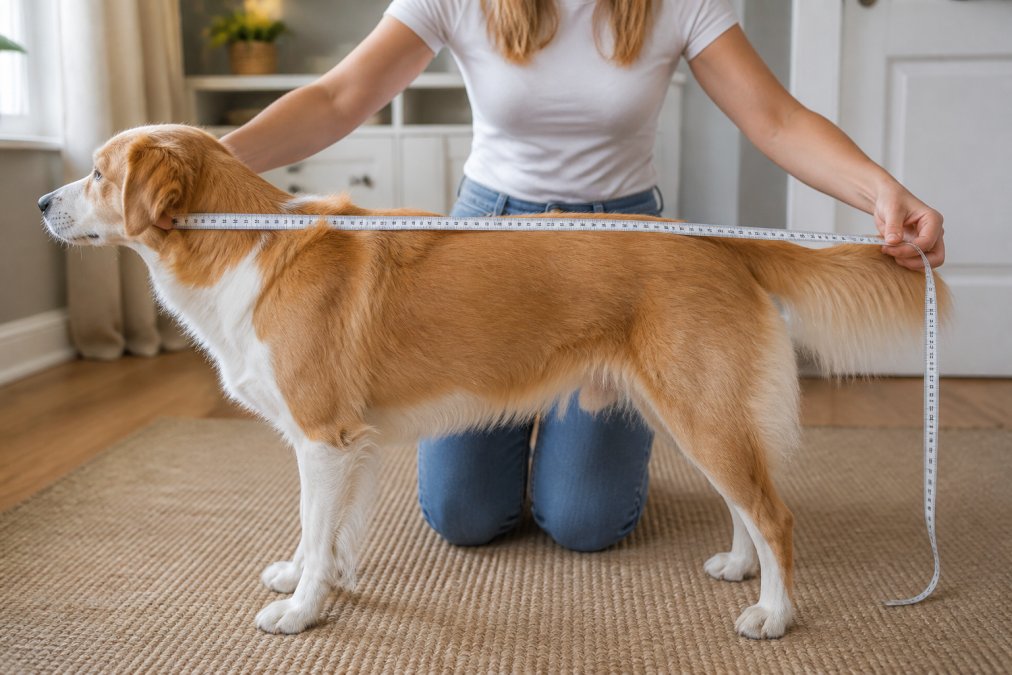
Most dogs need a carrier at least 5 centimetres longer than their body length to shift weight and adjust position. Common mistakes: measuring to the tail's end instead of the base, pulling the tape too tight, or measuring in an unusual position. If your dog's body length is 60 centimetres, you need a carrier at least 65 centimetres long. Breed alone doesn't determine size, a 15-kilogram dog isn't automatically the same length as another 15-kilogram dog.
Step 2: Measure Height from Ground to Shoulder
Have your dog stand on a flat surface and measure from the ground straight up to the highest point of their shoulder (not the head), keeping the tape vertical. Your dog needs at least 5 centimetres of clearance above their head to stand naturally without crouching. If your dog prefers to sit, also measure from the ground to the top of their head when sitting so you can choose a carrier that works for their preferred position.
Step 3: Measure Girth and Width for Comfort
Wrap the soft measuring tape around the widest part of your dog's chest (just behind the front legs), keeping it snug but not tight. Also measure across your dog's body from widest point to widest point, especially for broad-chested or wide-shouldered dogs. A good carrier gives your dog at least 10 centimetres of extra width on each side so they can turn around comfortably. Dogs that feel cramped become anxious; proper width lets them relax and feel secure.
Airline Approved Pet Carrier Requirements and Dimensions
If flying, the carrier must meet airline standards, but airline-approved dimensions are the minimum legal size, not the ideal comfort size.
Standard airline-approved in-cabin dimensions:
- Maximum length: 55 centimetres
- Maximum width: 40 centimetres
- Maximum height: 35 centimetres
- Maximum weight limit: usually 8-10 kilograms for in-cabin travel
These limits apply to in-cabin carriers. A carrier meeting airline dimensions is the minimum legal size, not the ideal comfort size. Airlines require only that your dog can stand, turn around, and lie down, not extra space for relaxation or stress relief.
If your dog's measurements are close to airline limits, choose between an airline-compliant carrier (55 × 40 × 35 cm) with minimal extra space, or a larger, more comfortable carrier that may need to be gate-checked. Many dogs travel more calmly in roomier carriers.
Contact your airline directly before purchasing. Soft-sided carriers compress; hard-sided carriers do not. Some airlines allow slightly larger soft-sided carriers under the seat if they compress to fit; others do not. Your airline's gate agent has the final say.

Under-seat dimension constraints: Most airlines require carriers to fit under the seat in front of you. Measure the space under your airline's seats before you fly. Some airlines have tighter restrictions than others. A carrier that fits one airline's seat might not fit another's.
What "airline approved" actually means: The carrier must have proper ventilation, secure latches, and enough space for your dog to stand and turn around.
How to Choose the Right Size Dog Carrier for Your Needs
Once you measure dog for carrier and have your measurements, match them to the right carrier type and size. Different carriers serve different purposes, and the way you measure should account for the carrier's design.
Breed-specific sizing reference:
- Small breeds (Chihuahua, Pomeranian, Toy Poodle): Body length typically 20-30 cm, height 15-25 cm. Suitable carriers: 35-45 cm length, soft-sided or backpack.
- Toy breeds (Shih Tzu, Maltese, Cavalier King Charles Spaniel): Body length typically 25-35 cm, height 20-30 cm. Suitable carriers: 40-50 cm length, soft-sided or small hard-sided.
- Small terriers (Jack Russell, Norfolk Terrier, Miniature Schnauzer): Body length typically 30-40 cm, height 25-35 cm. Suitable carriers: 45-55 cm length, soft-sided or hard-sided.
- Long-bodied breeds (Dachshund, Corgi, Basset Hound): Body length typically 40-55 cm, height 25-35 cm. Suitable carriers: 55-65 cm length, hard-sided preferred for support.
- Compact breeds (French Bulldog, Pug, Boston Terrier): Body length typically 30-40 cm, height 25-35 cm. Suitable carriers: 45-55 cm length, soft-sided or hard-sided.
- Medium breeds (Beagle, Cocker Spaniel, Schnauzer): Body length typically 40-50 cm, height 35-45 cm. Suitable carriers: 55-65 cm length, hard-sided recommended.
Key questions to ask before purchasing:
- Will you fly with this carrier, or just use it for car trips?
- Does your dog prefer soft or hard-sided carriers? (Observe whether they like enclosed spaces or prefer visibility.)
- Will you need to carry the carrier, or will it stay in the vehicle?
- How long will your dog spend in the carrier at one time?
- If flying, have you confirmed the carrier fits under your airline's seats?
Dog Travel Safety Tips When Using Your Measured Carrier
A properly measured carrier is only half the solution. How you use it matters just as much.
Before your trip:
- Let your dog spend time in the carrier at home before travel day. This reduces travel stress.
- Practice short trips first. Build up to longer journeys.
- Never force your dog into a carrier. Use treats and positive reinforcement.
During travel:
- Keep the carrier secure in your vehicle. Use a seatbelt or cargo net to prevent sliding.
- Provide water during long trips. Use a spill-proof bowl attached to the carrier.
- Never leave your dog alone in a parked car, even with windows down.
- Keep the carrier out of direct sunlight.
For air travel:
- Arrive early to allow time for security checks with your dog.
- Keep your dog's vaccination records and health certificate accessible.
- If flying, check with your airline about their specific pet carrier requirements before departure.
Signs your dog is stressed:
- Excessive panting or drooling
- Whining or barking
- Refusal to enter the carrier
- Loss of appetite
Frequently Asked Questions
How do I measure my dog's body length for a carrier?
Measure from the tip of your dog's nose to the base of their tail while they stand naturally on a flat surface. Use a soft measuring tape and keep it snug but not tight. This measurement determines the minimum length your carrier needs. Many carriers require at least 5-10 cm extra length beyond this measurement for comfort and movement.
What are airline approved pet carrier requirements I need to know?
Most airlines require carriers to fit under the seat. Check your specific airline's website before booking, as requirements vary. Your carrier must have ventilation on multiple sides, secure latches, and be rigid enough to hold its shape.
How do I choose the right size dog carrier for my dog?
Add 10-15 cm to your dog's body length measurement and 5 cm to their shoulder height to find the ideal carrier size. Your dog should be able to stand, turn around, and lie down comfortably without feeling cramped. Consider the carrier type. Match the carrier to your travel style, whether it's in-cabin flights, car travel, or hiking trips.
Should my dog be able to stand up fully in a carrier?
Yes, your dog should be able to stand with their head upright without touching the top. They should also turn around and lie down in a natural position. Carriers that are too small cause stress and restrict movement, while excessive space can make your dog slide around during transport. The right balance ensures comfort and safety during travel.
Measuring your dog properly takes 10 minutes and prevents weeks of buyer's remorse. Once you know your dog's exact dimensions, you can confidently choose a carrier that keeps them comfortable and safe. At Fur & Far, our curated selection of premium pet travel gear is designed with these measurements in mind. Shop Road Trip Essentials and find a carrier that actually fits your dog's unique shape and travel needs.